source: coursera.com
Showing posts with label Tips. Show all posts
Showing posts with label Tips. Show all posts
Thursday, June 27, 2013


Monday, March 18, 2013
Monday, February 18, 2013
Using the drying rack
 |
| Hold the thumbs over the painting on the way to the drying rack |
 |
| DO NOT slot the painting in between the racks |
 |
| Place the painting on the rack and bring down the next one |
Wednesday, February 6, 2013
Handling watercolour palette and brushes
Pupils should not wash their watercolour palettes under running water.

Dirty brushes should be gently clean under running water.


Dirty brushes should be gently clean under running water.


Monday, July 16, 2012
I See, I Think, I Wonder


I SEE / I THINK / I WONDER | |||||||
| A routine for exploring works of art and other interesting things | |||||||
| |||||||
| WHY | |||||||
| To help student make careful observations and thoughtful interpretations; to stimulate curiosity and set the stage for inquiry | |||||||
| WHEN | |||||||
| Use this routine when you want students to think carefully about why something looks the way it does or is the way it is. | |||||||
| HOW | |||||||
| Ask students to make an observation about the artwork or topic and follow up
with what they think might be going on or what they think this observation might
be. Encourage students to back up their interpretation with reasons. Ask the
students to think about what this makes them wonder about the artwork or topic.
The routine works best when a student responds by using the three stems together at the same time, i.e., I see?, I think?, I wonder ?. However, you may find that students begin by using one stem at a time, and that you need to scaffold each response with a follow up question for the next stem. The routine works well in a group discussion but in some cases you may want to have students carry out the routine individually on paper or in their heads before sharing them out as a class. Student responses to the routine can be written down and recorded so that a class chart of observations, interpretations and wonderings are listed for all to see and return to during the course of study. Taken from http://pzweb.harvard.edu/tc/see_think_wonder.cfm |

Monday, July 9, 2012
Colour pencil techniques

Pencil strokes
Children are encouraged to keep their colour pencil strokes in the same direction. In the above example, this child has strokes of different directions.
Blending
Children can experiment with building up layers of different colours to make their artwork more interesting.
Shadow
They can include light and dark components in their artwork by applying heavier pressure.
Sharpening
Minimize sharpening by rolling the colour pencil in your hand every few strokes for a new sharp pencil point.
Thursday, June 7, 2012
The Basic
There are occasions when children forgot to write their names, class, date and title before beginning their art work. Therefore, it is habit for me to request them to write these down before I begin my instructions. These are samples of pupils' good work:
-------------------------------------------------------------------------------------------------------------------------------
 |
| Very neat & tidy. |
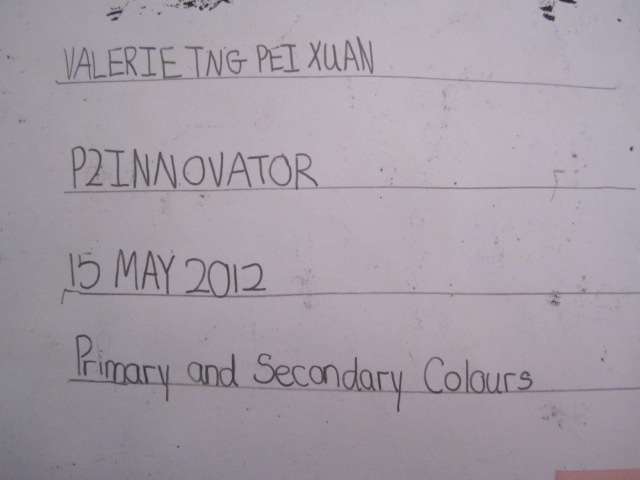 |
| This is acceptable too. |
 |
| Writing with a crayon is not encouraged. |
Wednesday, June 6, 2012
Painting


The circle below contains less yellow pigment because the paint is not well-mixed (with water). Pupils were taught to mix the paint in circular motions for 10 times and repeat the actions on the other side of the paint brush.
Tuesday, June 5, 2012
Preventing the appearance of paper pulp
Children are reminded to mix the colours well before painting. (See picture below) Result of excessive water and the repeated action of painting on the same spot causes paper pulp to appear. If colours were well-mixed, there is sufficient colour pigment on the paint brush and therefore children do not need to paint on the same spot repeatedly.
Appearance of paper pulp in children's painting is often associated with dull colours as there isn't enough colour pigment.
Appearance of paper pulp in children's painting is often associated with dull colours as there isn't enough colour pigment.
 |
| Appearance of paper pulp |
Monday, June 4, 2012
Storage of paint brushes
Children are encouraged to clean and store their paint brushes properly to ensure durability.
Paint brushes can be washed thoroughly under running water and gently clean the bristles with their fingers.
Ensure that the brushes are not resting on the bristles when leaving it to dry.
Paint brushes can be washed thoroughly under running water and gently clean the bristles with their fingers.
Ensure that the brushes are not resting on the bristles when leaving it to dry.
 |
| Result of resting on bristles while drying |
Sunday, March 11, 2012
Drawing tip
 The children were taught to draw by not exerting too much pressure on their drawing paper. One, they can erase the pencil marks easily. Two, they will prevent white lines from appearing when they are colouring. The lines are harmless but somehow they spoil the finished pieces.
The picture on the left shows a dent created on the paper surface when one exerts too much pressure while drawing. This dent is irreversible. The tip of a colour pencil is too broad to fit any colour in the dent, therefore a white line is often seen after colouring.
Subscribe to:
Posts (Atom)